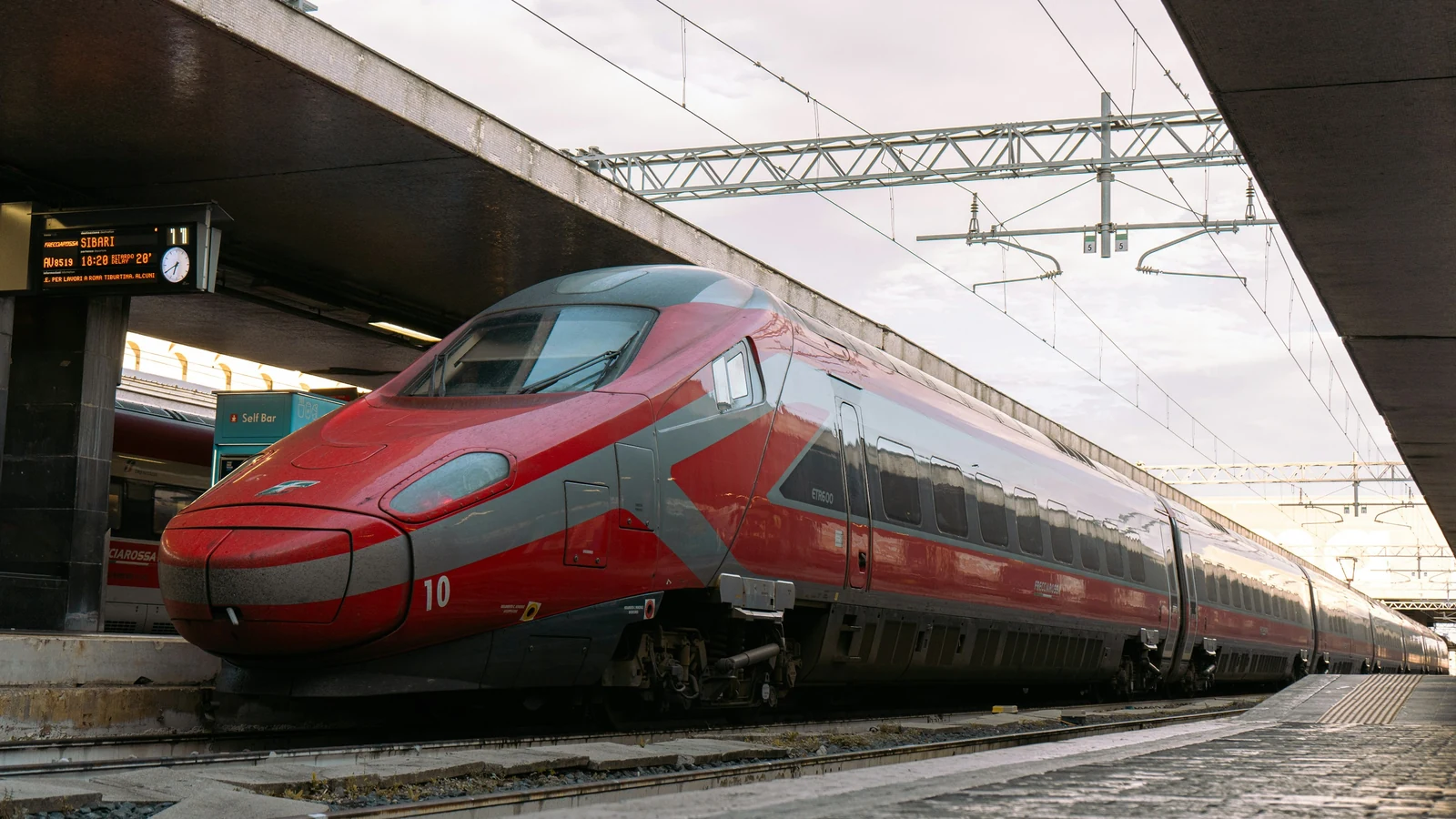
Frecciarossa Trains — Italy at 300 km/h
The Frecciarossa is Trenitalia's flagship high-speed train, running at up to 300 km/h across Italy and on to Paris. Launched in December 2008, it links Milan and Rome in as little as 2 h 59 min and offers four classes of service, at-seat power and free WiFi on every train.
What are Frecciarossa high speed trains?
The Frecciarossa ("red arrow") is Trenitalia's flagship high-speed train service, part of the wider Trenitalia rail network, running at up to 300 km/h on Italy's dedicated high-speed lines. Introduced in December 2008 with the opening of the Milan–Bologna high-speed line, it now forms the backbone of Italian intercity travel, linking Turin, Milan, Bologna, Florence, Rome, Naples and Venice, plus a cross-border service to Paris operated by Trenitalia France. If you're planning rail travel in Italy or to Paris and want clear details on routes, classes, fares and onboard service, this guide is for you.
Two generations of trains carry the brand. The original ETR 500 sets were joined in June 2015 by the Frecciarossa 1000 (ETR 1000), a 200-metre, 8-car train with 462 seats that is designed for 360 km/h, though it runs commercially at 300 km/h. Full details of the fleet and timetables are published by Trenitalia and its parent company FS Italiane. Below you'll find the key facts that matter when choosing Frecciarossa trains: speed and journey times, route coverage, class differences and comfort, booking tips, onboard amenities, luggage rules, and practical answers on connections, prices and travel advice.
On its core Milan–Rome route the Frecciarossa has largely replaced flying: the fastest trains cover roughly 570 km in 2 h 59 min city centre to city centre, while a Milan–Rome flight takes about 1 h 10 min in the air but typically 3.5–4 hours door to door once airport transfers to Linate or Malpensa and Fiumicino, check-in and security are added. Frecciarossa is also much faster than regional and Intercity trains on the same corridors. Advance train fares from around €30 are usually competitive with budget flights, and roughly two-thirds of travellers on the corridor now choose rail. Since 2012 Trenitalia has also faced onboard-quality competition from Italo, the private operator running the same high-speed lines — one reason Frecciarossa service standards are unusually high.
Two-generation fleet
ETR 500 sets and the newer Frecciarossa 1000 — 8 cars, 462 seats, designed for 360 km/h and also approved for France and Spain.
Turn-up-and-go frequency
At peak times a Frecciarossa leaves Milan for Rome roughly every 30 minutes, from early morning until mid-evening.
Train beats plane
About two-thirds of Milan–Rome travellers now take the train rather than fly, thanks to the sub-3-hour centre-to-centre journey.
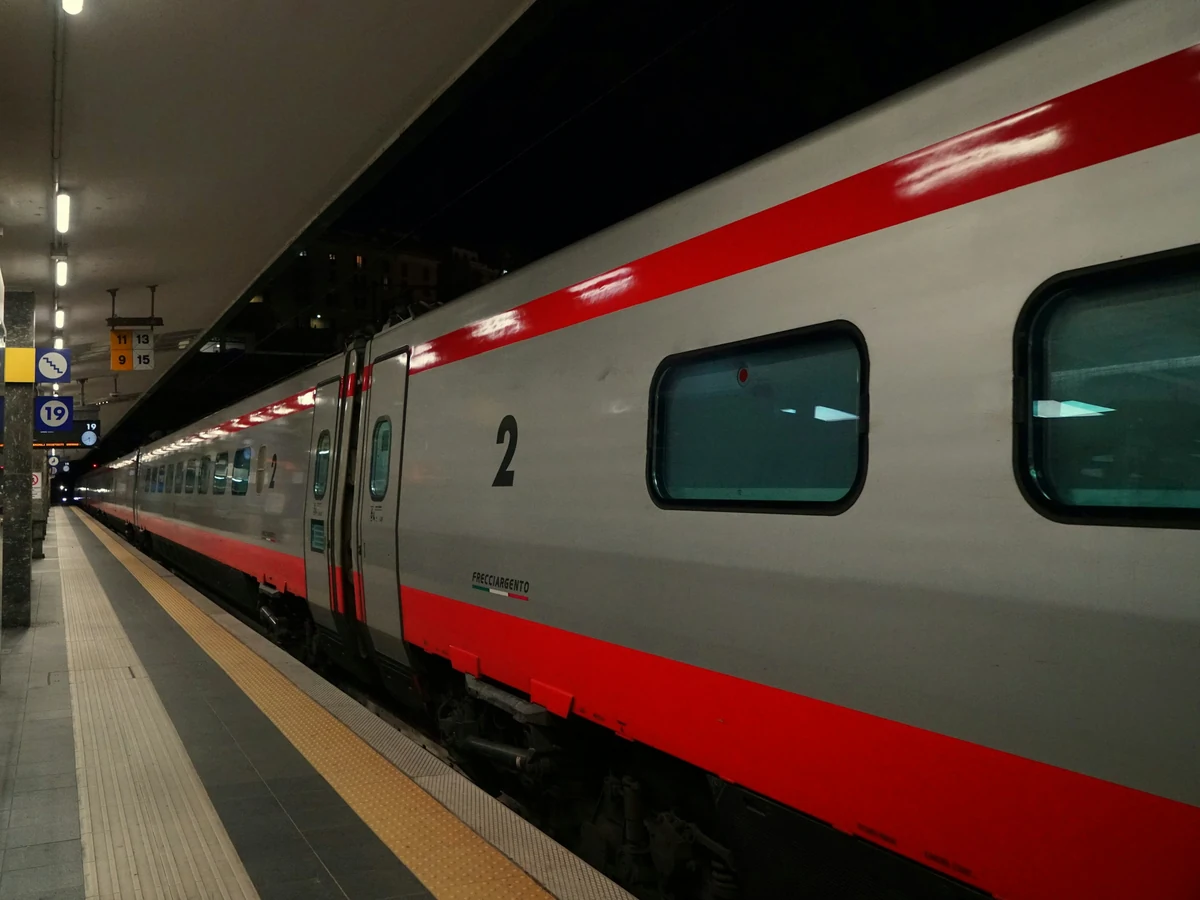
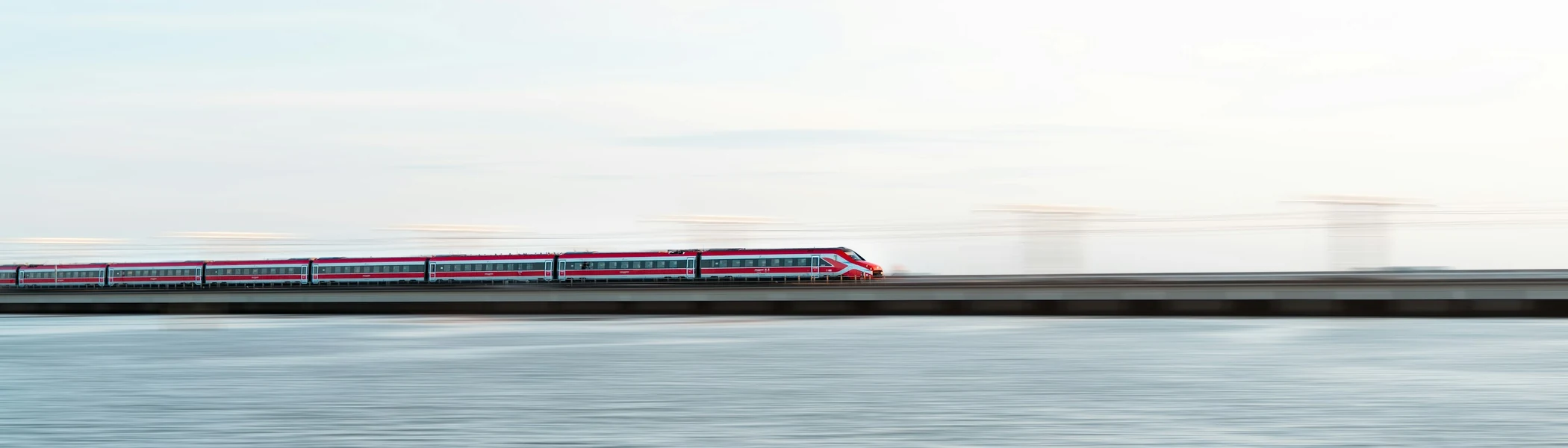
Frecciarossa routes and journey times
Frecciarossa trains operate on Italy's major-city network along the following routes: the Turin–Milan–Bologna–Florence–Rome–Naples spine, the Milan–Venice corridor, and international services including Milan to Paris. Times below are the fastest scheduled services; most trains with intermediate stops take 15–40 minutes longer, and Bologna–Florence is served around 70 times daily.
| Route | Fastest time | Distance |
|---|---|---|
| Milan – Rome | 2 h 59 min | ~570 km |
| Rome – Naples | 1 h 10 min | ~210 km |
| Milan – Naples | 4 h 15 min | ~780 km |
| Turin – Milan | 55 min | ~150 km |
| Milan – Venice | 2 h 15 min | ~265 km |
| Rome – Florence | 1 h 32 min | ~260 km |
| Milan – Florence | 1 h 50 min | ~300 km |
| Venice – Rome | 3 h 45 min | ~530 km |
| Milan – Paris | 6 h 48 min | via Turin & Lyon |
The Milan–Paris Frecciarossa, run by Trenitalia France, resumed in April 2025 with two daily departures each way after a 19-month landslide closure — but note the 2026 engineering-works warning in the tips section below. Compare live times and fares for any route at trenitalia.com.
Book your route ↗Frecciarossa seat classes compared
Frecciarossa high speed trains offer passengers four classes — Standard, Premium, Business and Executive — rather than a simple first/second split. All four include free WiFi, at-seat power sockets and access to the FRECCIABistrò bar car. Typical fare ranges below are for Milan–Rome; fares generally use dynamic pricing and rise as trains fill.
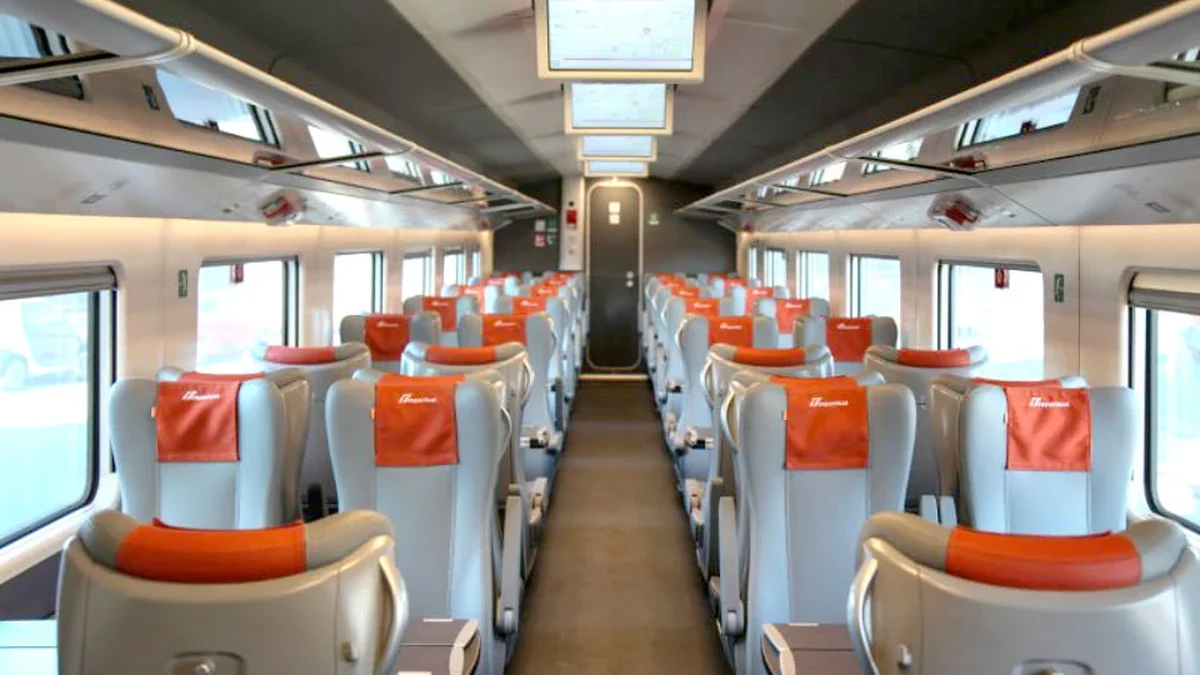
Standard
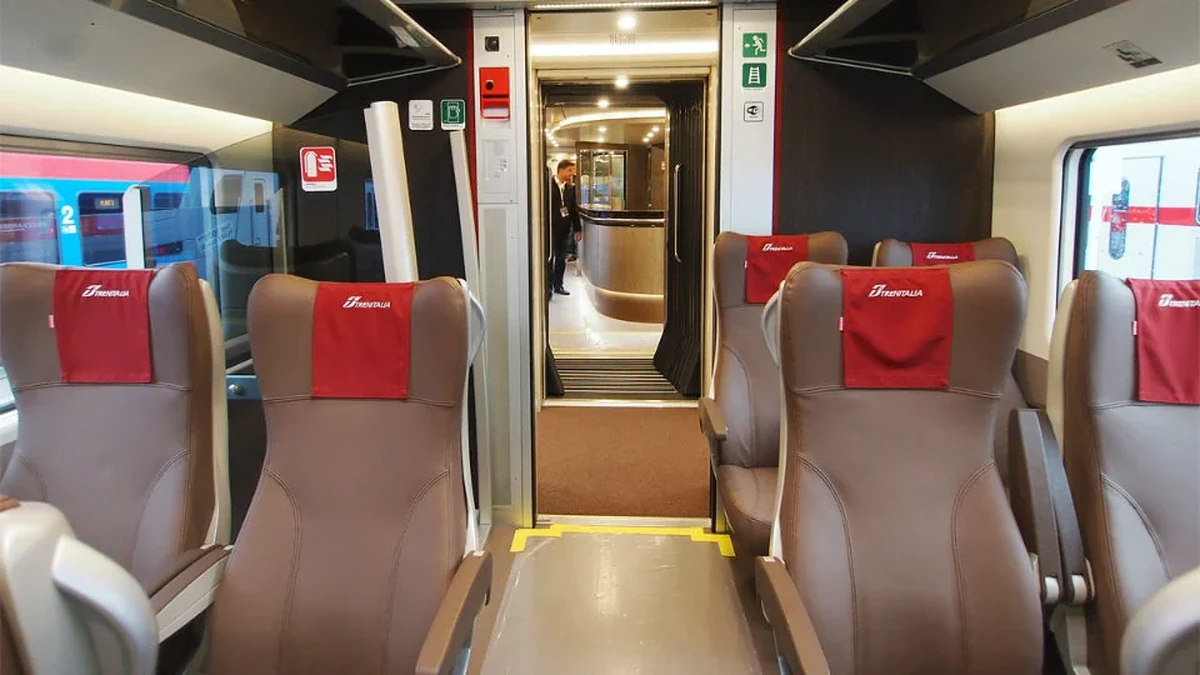
The best-value option: 2+2 ergonomic seats with generous legroom by airline standards. Typically €30–€100 Milan–Rome depending on how far ahead you book and fare flexibility. Fine for any journey under four hours.
- 2+2 leather seats, tables at some bays
- Power socket and reading light at every seat
- Free WiFi and onboard entertainment portal
Premium
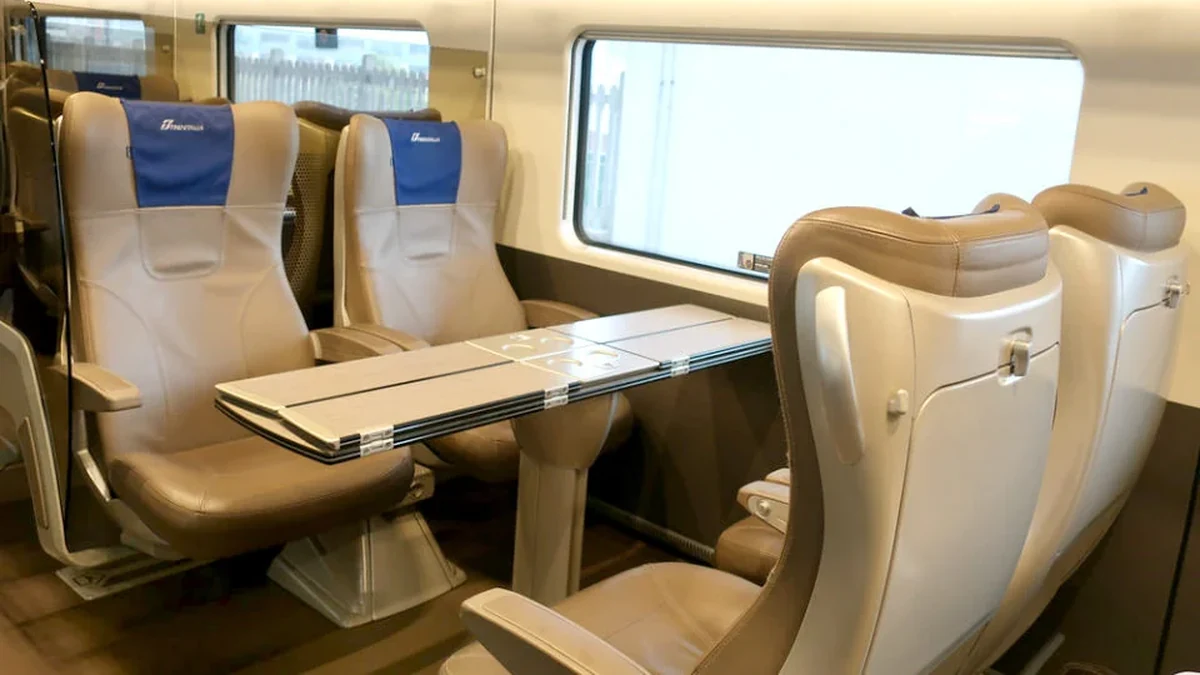
The same 2+2 layout as Standard but in a quieter part of the train, with a complimentary welcome drink—such as a soft drink—and complimentary snacks served at your seat. Usually only €5–€15 more than Standard (typically €35–€115 Milan–Rome), which makes it a cheap upgrade.
- Welcome drink, including a soft drink, and complimentary snacks included
- 2+2 leather seating, quieter coaches
- Best value-per-euro upgrade on the train
Business
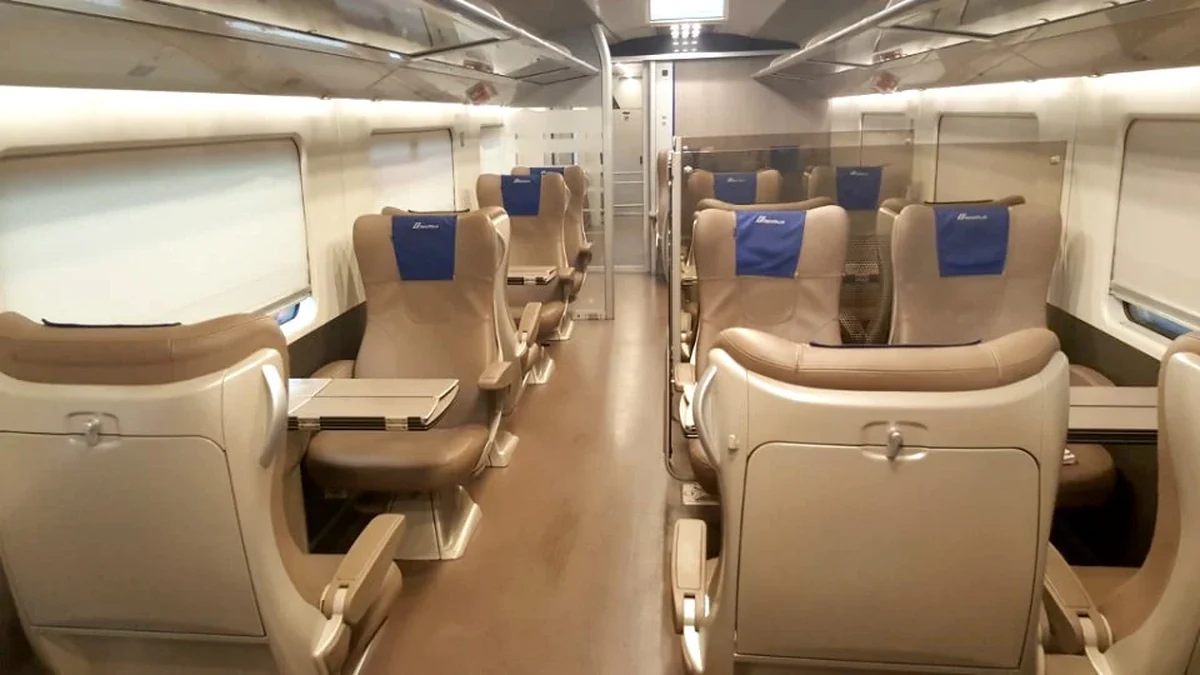
Wider seats in a 2+1 layout with more recline and workspace, plus the at-seat welcome service. Typically €45–€135 Milan–Rome. Some coaches offer the Salottino — a private four-seat lounge compartment bookable for a small supplement, ideal for families or meetings.
- 2+1 layout with wider seats and armrests
- Welcome drink and snack service
- Salottino private compartments on many trains
Executive
A dedicated coach with around ten reclining leather armchairs that swivel to face the direction of travel for maximum comfort, plus a six-seat meeting room, at-seat meal service and FRECCIALounge access at major stations. Sold mainly at flexible Base fares, typically €150–€250 Milan–Rome.
- Armchair seating in a near-private coach
- Complimentary meal, drinks, and snacks served at seat
- Station lounge access and fast-track boarding
Practical Frecciarossa booking and travel tips
Frecciarossa fares are fully dynamic, so how and when you book matters more than on most European railways. These tips come from patterns that hold true across the network.
Book 2–4 weeks ahead for the cheapest fares
Sales usually open four to six months in advance with each timetable release, and the cheapest Super Economy allocation (from around €30 Milan–Rome) sells first. Midweek and midday departures are consistently cheapest; Friday and Sunday evenings between Milan, Rome and Naples are the most expensive trains of the week and can sell out entirely around public holidays like Ferragosto (15 August).
Understand the three fare types before you buy
Super Economy is non-refundable and non-changeable — miss the train and the ticket is lost. Economy allows date/time changes for a fee before departure. Base costs the most but is fully flexible and refundable with a small deduction, and lets you board an earlier or later train the same day in some cases. If your plans are firm, Super Economy is fine; if not, the Base premium is genuine insurance.
Manage your scenery expectations — and pick the right leg
Italian high-speed lines, unlike the conventional railway lines used by slower services on other routes, are engineered for speed, not views: the 79 km Bologna–Florence section runs almost entirely in tunnel, and much of Milan–Bologna is walled or sunken. The scenic exceptions are the Alpine crossing between Chambéry and Turin on the Paris route, and the causeway across the Venetian Lagoon on the final approach into Venezia Santa Lucia, with water on both sides.
Station tactics at Milano Centrale and Roma Termini
Both stations use ticket-check gates at the platform head, and the departure platform often only appears on the boards 10–15 minutes before departure — so wait near the boards, not at a guessed platform. Platforms are long; Executive and Business coaches usually stop furthest from the gates. Arriving 20 minutes early is plenty; there is no check-in.
Rail passes work, with a reservation fee
Eurail and Interrail passes are valid on domestic Frecciarossa trains, and an Eurail Pass still requires reservations, which are mandatory on Frecciarossa high-speed routes; expect around €13 in Standard class, bookable online or at stations. The Milan–Paris route, run separately by Trenitalia France, historically did not accept passes but begins accepting Interrail/Eurail from 1 June 2026 at €12 (2nd class) or €15 (1st class) per leg.
Know the honest limitations
The Milan–Rome–Naples corridor is congested, and delays of 10–30 minutes are not unusual; Trenitalia compensation only starts at 25% of the fare for delays of 60–119 minutes (50% beyond that). Overhead luggage racks fill quickly on peak trains, so board early with large bags. And note the Paris route is fully closed from mid-September to mid-October 2026 for Mont Cenis line engineering works.
Frecciarossa onboard amenities
Every Frecciarossa carries the same core amenities regardless of class, including air conditioning, WiFi and power, with service extras layered on top in Premium, Business and Executive.
WiFi & entertainment portal
Free WiFi in all four classes after a quick registration, plus the onboard FRECCE portal with films, news and live journey info. Expect the connection to drop repeatedly in the long Apennine tunnels between Bologna and Florence.
Power at every seat
Every seat on both the ETR 500 and Frecciarossa 1000 has a standard European power socket, so you can work or charge for the full journey — no seat-hunting for outlets required.
FRECCIABistrò bar car
A staffed café-bar car open to all classes, serving espresso, wine, panini and hot snacks. Prices are reasonable by station standards, though the selection thins out on evening services.
Silence areas
Many services designate quiet coaches (Area Silenzio) where phone calls are discouraged and announcements are minimised — worth requesting at booking if you plan to work or sleep.
Luggage space
No weight limit or fees: bring what you can carry and stow it yourself. Racks sit above seats and at coach ends, plus mid-coach stands for large cases. There is no checked-luggage service on any Frecciarossa.
Salottino & meeting room
Business class offers Salottino private four-seat compartments on many trains, and the Frecciarossa 1000's Executive coach includes a bookable six-seat meeting room with a table and screen.
Pets on board
Small pets travel free in a carrier (max 70×30×50 cm); larger dogs need a muzzle, lead and their own reduced-fare ticket. Peak-morning restrictions can apply to large dogs on busy weekday services.
Accessibility
Both trainset generations carry wheelchair spaces with adjacent companion seats, accessible toilets, and LED lighting. Free boarding assistance is arranged through Trenitalia's Sala Blu service, ideally booked 24 hours ahead.
Frecciarossa trains — frequently asked questions
The questions travellers ask most before boarding a Frecciarossa, answered directly. If your question isn't covered, timetables and fares for every route are a search away.
Book ticketsWhat is a Frecciarossa train?
A Frecciarossa is Trenitalia's flagship high-speed train and one of its main train types, running at up to 300 km/h on Italy's dedicated high-speed network since December 2008. It connects Turin, Milan, Bologna, Florence, Rome, Naples and Venice, plus Paris via Trenitalia France, with four onboard classes for passengers from Standard to Executive.
How fast do Frecciarossa trains go?
Frecciarossa trains run commercially at up to 300 km/h (186 mph) on Italian high-speed lines. The newer Frecciarossa 1000 is designed for 360 km/h, but infrastructure and signalling currently cap regular service at 300 km/h. On conventional lines, such as Milan–Venice east of Brescia, speeds are considerably lower.
What is the difference between Frecciarossa classes?
Standard has 2+2 seating; Premium adds a welcome drink and snack for a small surcharge; Business has wider 2+1 seats plus optional private Salottino compartments; Executive is a dedicated coach with about ten armchairs, a meal service, a meeting room and station lounge access. All classes include free WiFi and power sockets.
Do I need a seat reservation on Frecciarossa trains?
Yes — every Frecciarossa ticket includes a mandatory reservation for a specific train and seat, so there is no standing or open boarding. This also means popular departures genuinely sell out, especially Friday and Sunday evenings and around Italian holidays, so booking ahead is about availability as well as price.
Is there WiFi on Frecciarossa trains?
Yes, free WiFi is available in all classes after registering on the onboard portal, which also offers entertainment and live journey tracking. Coverage is good on open stretches but drops in tunnels — most noticeably on the almost entirely tunnelled Bologna–Florence section — so download anything important beforehand.
Are Frecciarossa trains covered by Eurail and Interrail passes?
Yes, domestic Frecciarossa trains accept Eurail Pass and Interrail passes with a compulsory seat reservation of around €13 in Standard class. The Milan–Paris service, operated by Trenitalia France, starts accepting passes from 1 June 2026 with a €12 (2nd class) or €15 (1st class) reservation fee.
Do children travel free on Frecciarossa trains?
Children under 4 travel free without their own seat. Trenitalia's Bimbi Gratis offer additionally lets under-15s travel free with their own seat when booked as part of a small family group on many Frecciarossa services, subject to availability — it must be selected as a specific fare when booking.
Can I take luggage or a bike on the Frecciarossa?
Luggage is free with no weight limit — you carry and stow it yourself. Bicycles are only allowed folded or disassembled inside a bike bag; full-size assembled bikes are not carried on Frecciarossa trains, unlike Italian regional services, so cyclists should plan connections accordingly.
How far in advance should I book Frecciarossa tickets?
Two to four weeks ahead usually captures Super Economy fares from around €30 on Milan–Rome; when comparing schedules, check the exact departure time, as booking on the day can cost three times more. Sales open four to six months out. You can compare schedules and book at trenitalia.com.
Ready to ride the Frecciarossa?
Compare Frecciarossa schedules, classes and fares for routes connecting major cities across Italy and extended to Paris, with frequent connections.
Book Frecciarossa Tickets ↗